
“There you have the semblance of life, but you do not express its fullness and effluence, that indescribable something, perhaps of the soul itself, that envelopes the outlines of the body like a haze; that flower of life, in short, that Titian and Raphael caught.”
Honoré de Balzac, The Unknown Masterpiece
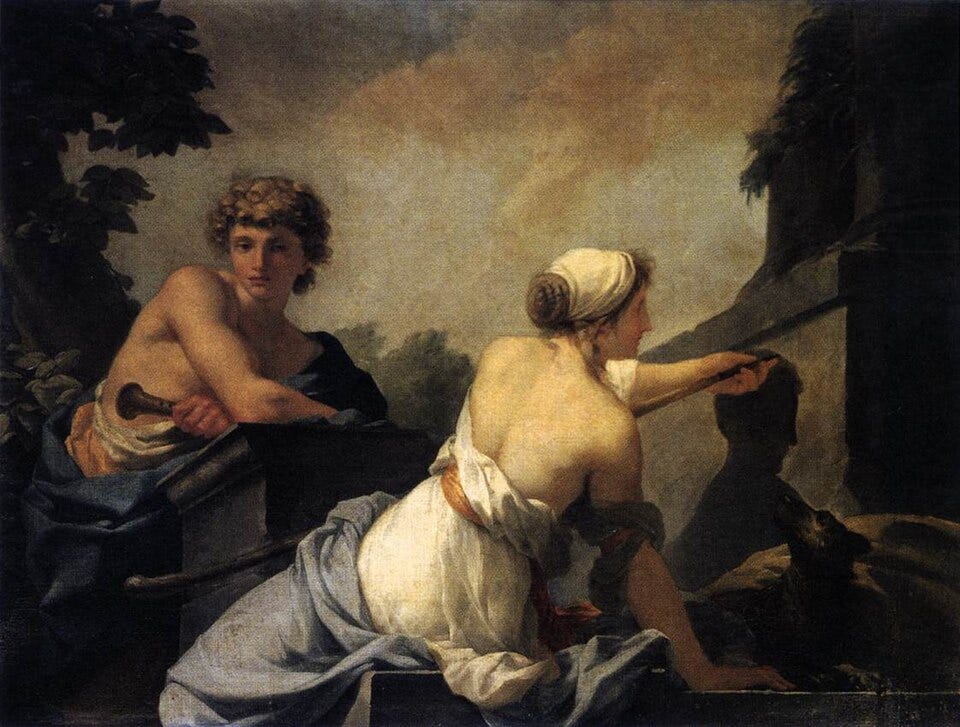
As the myth goes, a young Corinthian girl birthed painting when she traced the shadow of her lover’s profile against a cave wall. He will depart for an extended journey in the morning. She materializes his imminent absence in gesture and line, which predicates the origin of figurative art upon incompleteness, memory, and love.1
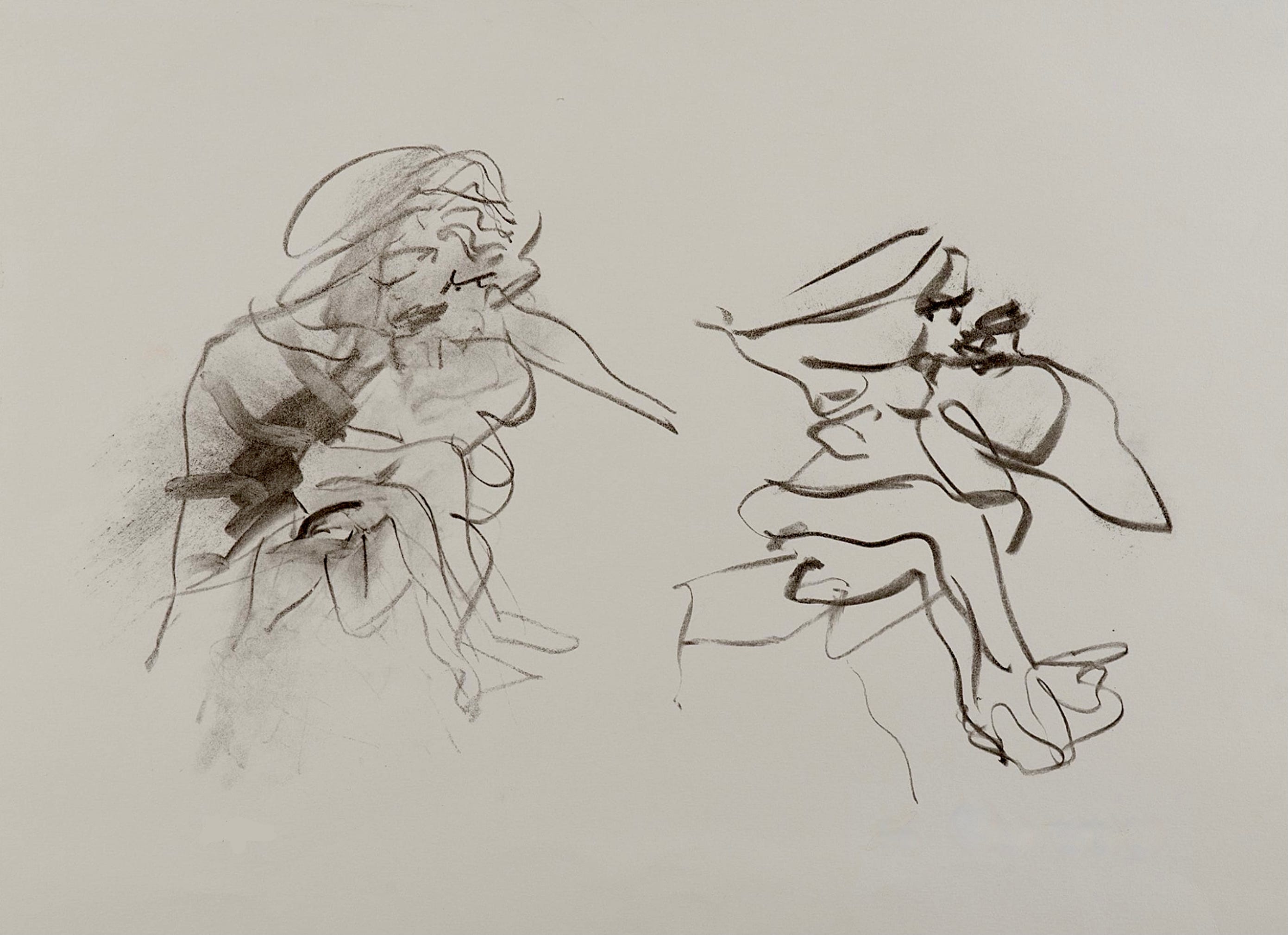
I was on a little abstract kick for a few weeks in my practice. I have never been able, truly able, to do that: to let a purely imaginative impulse drive my hand, to scribble and experiment, to draw shapes and let one gesture carry you forward in the absence of a reference. Even as a child I felt incapable. I always needed an object, or preferred an object. It is a familiar language— a particular attunement with the world— to capture a semblance of likeness. But I always felt envious of those who gave themselves permission to create without it. I have slowly granted myself the permission to stretch my limbs, to let my hand wander this way and that. Little by little.
I’ve come back to representation lately out of a certain need, whose nature is what I hope to articulate in this entry. I guess it is a little bit perverse, a little bit self surveilling— using my art historian brain to try and understand what I’m making, when, where, and why. Drawing (and painting) in the past few weeks has come out of necessity; my copium, if you will. I moved back to New York last week from the Philadelphian suburbs, where I had studied and lived for the past four years. As the dawn of college graduation approached, I found myself opening nearly every conversation with, hey so is it hitting you yet. I wasn’t as much terrified of leaving college as I was enamored and dizzy. I always make a big deal out of things (granted, graduating is a big deal). What struck me was the fast-approaching imminence of absence.
I. Line: Searching and losing
In its essence, a drawing (at least the type I am concerned with) is line. A line originates at a point: the landing locus of the drawing instrument. Doesn’t matter what medium (sort of). I used to feel such horror when I found myself in front of an empty page— where do I place this point, where do I extend this line? What am I supposed to do? Faced with the overwhelming freedom of creative will, I’ve found solace in the object, in the landscape, in the portrait. Once establishing a loose concept of what the image should convey, the line extends, and tension builds upwards in a theater of decision. The static page obtains noise and tempo through movement.2 This introduces the problem of temporality, or the contained existence of the drawing’s creation within linear time. As the line grows and transforms, the form appears and vanishes from one moment to the next.3 Like memory, we may return to the silhouette of the real thing, and yet it mutates, it flitters in and out of consciousness. The drawing is a searching; a perpetual arrival and departure.
Roberto Carraciolo, a former mentor, crystallized the link between memory and drawing for me from a functional perspective. His words—delivered slowly and pointedly—resurface frequently in my mind and hand. When we move about our lives through the phone camera, when we digitally catalog what we find beautiful and striking, we delegate our memory to the machine. Drawing is a way to reclaim agency over memory (and perhaps beauty) through the documentary practice. The endeavor to draw encapsulates much more than the image itself, as we see in development of point and line. Drawing, which is the structure, the skeleton, the most rudimentary signifier of any object, has its own system of epistemology in the act of creation— it is a way of knowing and of studying the world.
We should infuse the things we observe with the intensity of our emotions and with a deep sense of affinity. We should make them our own where the heart is concerned, as well as in an intellectual sense. Only then will they surrender their secrets to us, for enthusiasm heightens and refines our perception. As with the lover who discovers new perfections every day in the woman he adores, he who studies an object with an endless sense of pleasure finally discerns interesting details and unusual properties that escape the thoughtless attention of those who work in a routine way.
Santiago Ramon y Cajal, Advice to a Young Investigator 4
I remember this brisk and biting early January afternoon in Tarquinia. My numb and gloved hands on the edge of the Etruscan walls that enveloped Santa Maria di Castello. I had Da Vinci’s Arno River Valley drawing pulled up on my phone, adjacent to my sketchbook. It was barely legible in the 11am sun, which swallowed the pathetic screen, and soaked deliciously into the rolling hills. I wanted to study the rhythm of Leonardo’s lines, subsuming the landscape into this language. I attempted to emulate a horizontality in the reduction of his trees, and to contour a sense of the landscape’s brail, but his drawing did not have the answer, and neither did mine: everything sat somewhere in between, surrendered to the actuality of what was in front of me. How do I digest this? How do I assimilate it? There were too many decisions to make, and I drank this tension cautiously.
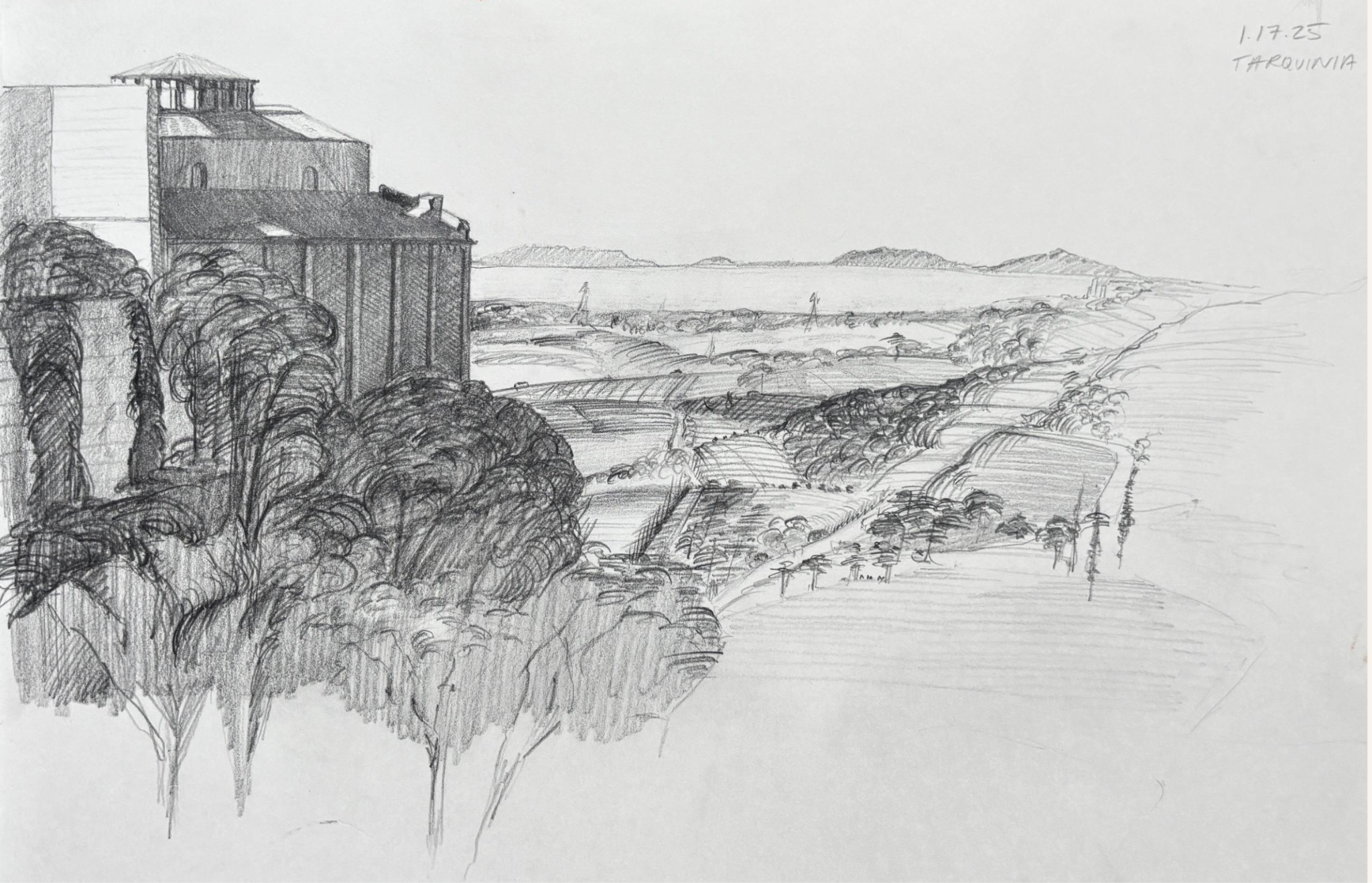
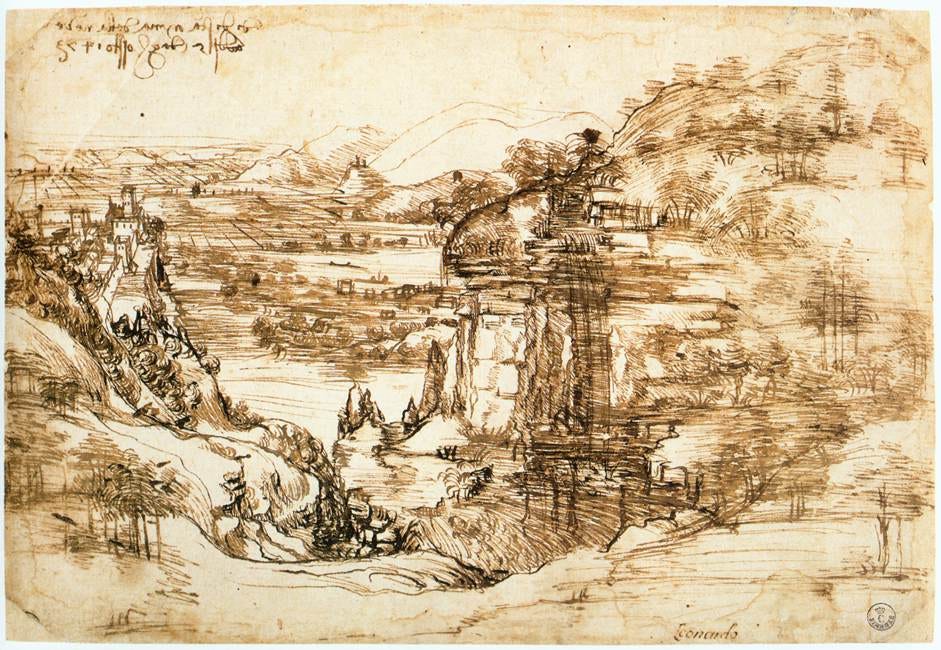
Roberto had told me my hand looks like it is searching for something it is afraid of losing, which I mentioned in my last studio entry on the metaphysical world of the picture plane. This was during our very last discussion, before I left Rome, as I just began to search (with a bit less desperation) for a “completeness” in the drawing. But searching for something I am afraid of losing captures only a fraction of the problem. The hand is searching for what it cannot obtain at all. It is the pity of the lover’s traced silhouette, which elicits the sensations of his presence without the ultimate embodiment; it is the sound and space of gorgeous valleys compressed into three lines of graphite. It is the saccharine twinge of memory, however lovely or awful.
This is the tension of the plastic art. The sensations of experience are overwhelmingly mutable, and the depiction exploits this mutability, somewhat pathetically. Kandinsky uses the windowpane metaphor: the windowpane compresses sensorial experiences of a busy street, removing us from participating in the reality that sits behind the object.5 The painting (or drawing) provides a subset of this sensory data, the way our memories do— but they will never and can never be complete.
II. In the Wake of Departure
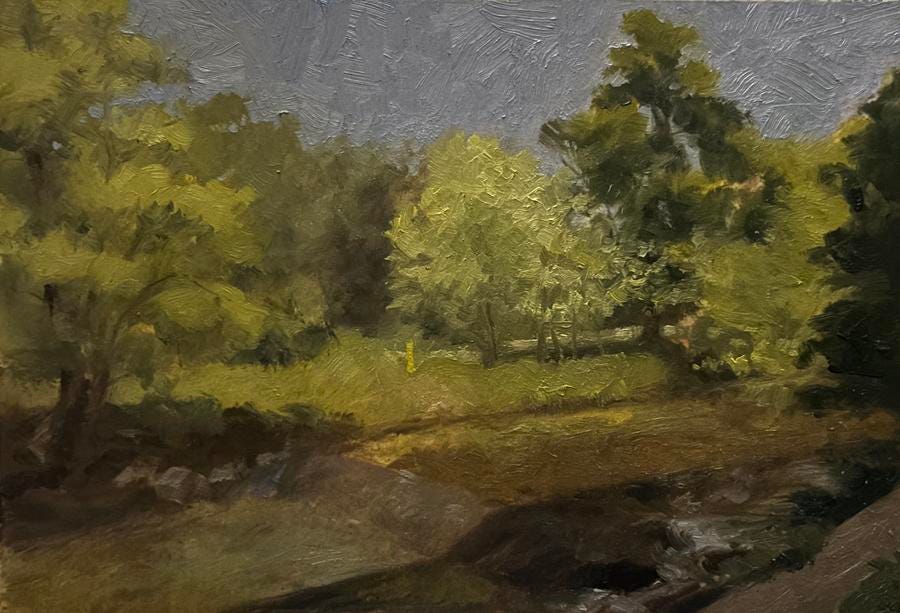
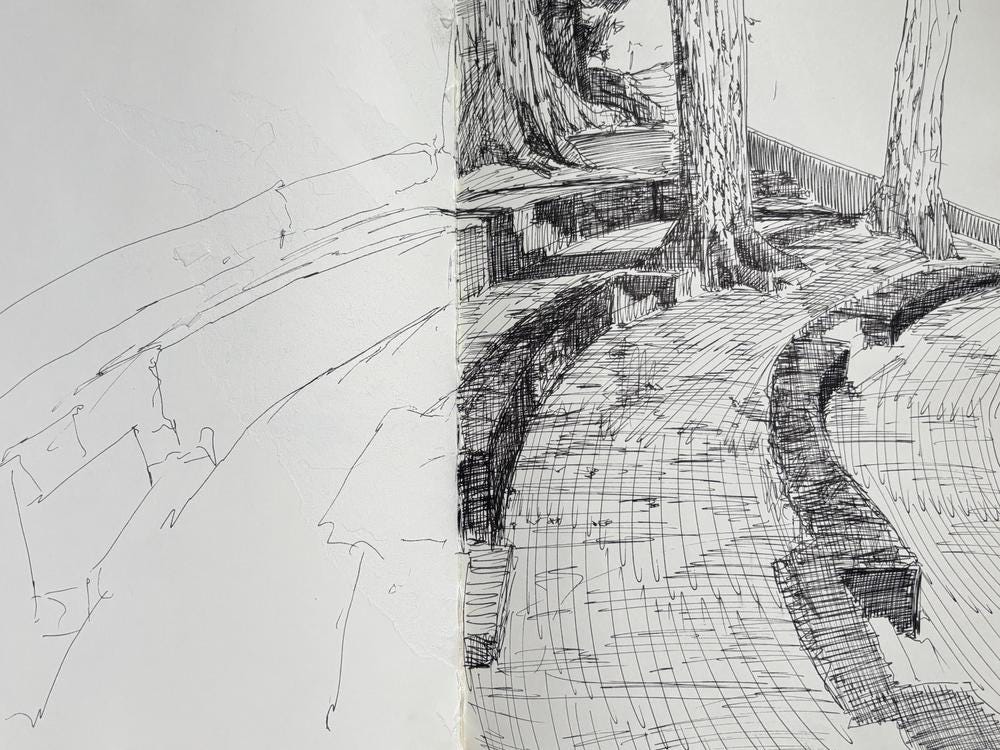
My initial draw to this school was its natural beauty. There’s an outdoor amphitheater tucked into the wood’s periphery; semicircular rows of tiered grass and stone orbit towers of tulip and oak trees. A shallow creek snakes itself—like ribbon falling in the air—along the bottom of the wooded valley. Oasitic gardens of fragrance and color quietly intermit a handful of bluestone and granite buildings, which reflect a lilac sandstone during the early sunset. The flowerbeds around campus always made me think of my mom—a passionate gardener—who became a kid at the candy store whenever she’d visit me, telling me about this plant and that plant, and how lucky I was to be surrounded by such verdant abundance.
I knew this four years ago, but since then, I have weaved myself— my memories, my friendships, my rituals— into the formal architecture of this space. I was, in some way or another, more drawn to this aspect than anything else. During the last week before graduation, with no more indoor space to paint, I built momentum in plein air (outdoor) studies. I divided my days into painted pages, selecting locations with their own profiles of memory and sensation: the creek under the bridge, the rose garden looking upon the library, and the creek in the woods, where the stream bends into periphery. They very quickly became a necessity. I remembered during my study in Florence, working from the figure, when I was instructed to imagine the form of the model’s body traveling through– through my eyes, down my arm, into the brush and onto the canvas. Now, the plein air was a composite of precious sensorial data. It was my grasp on the moment, a means to evidence my existence in the decision of a branch’s angle or geometry of the sky’s edge. It would preserve a fraction of this feeling that will fade from memory, whose resolution will compress, and texture will dull.
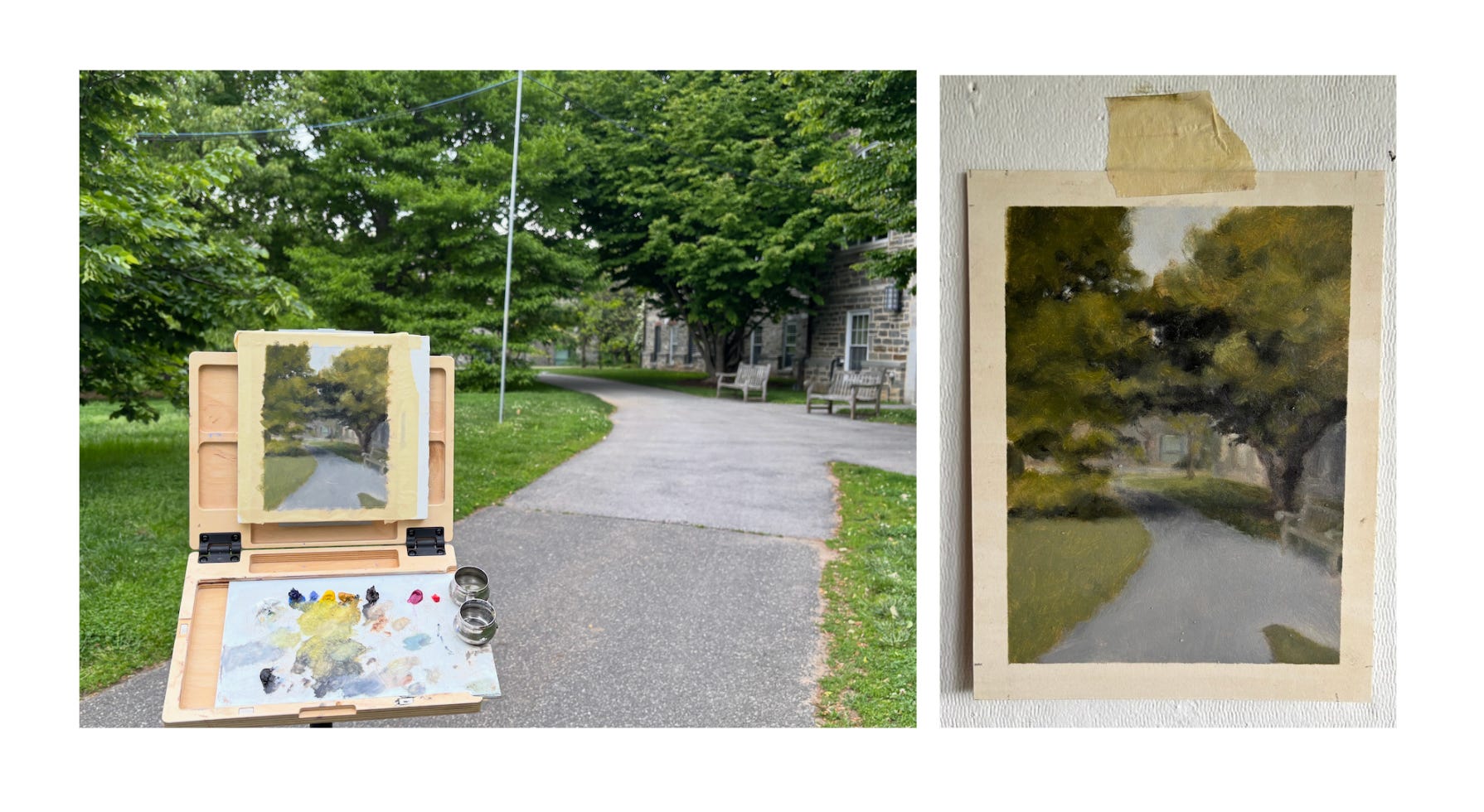
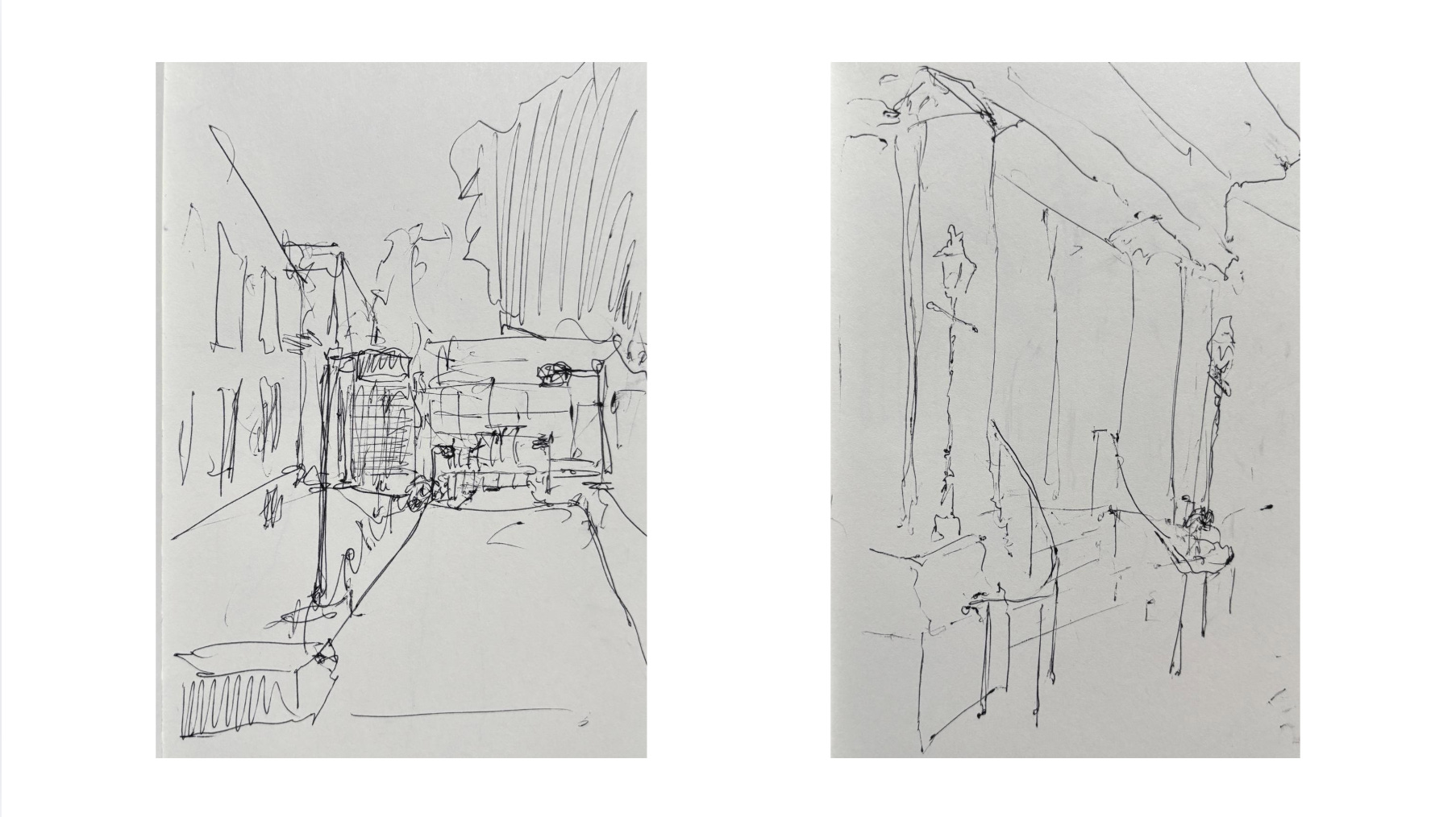
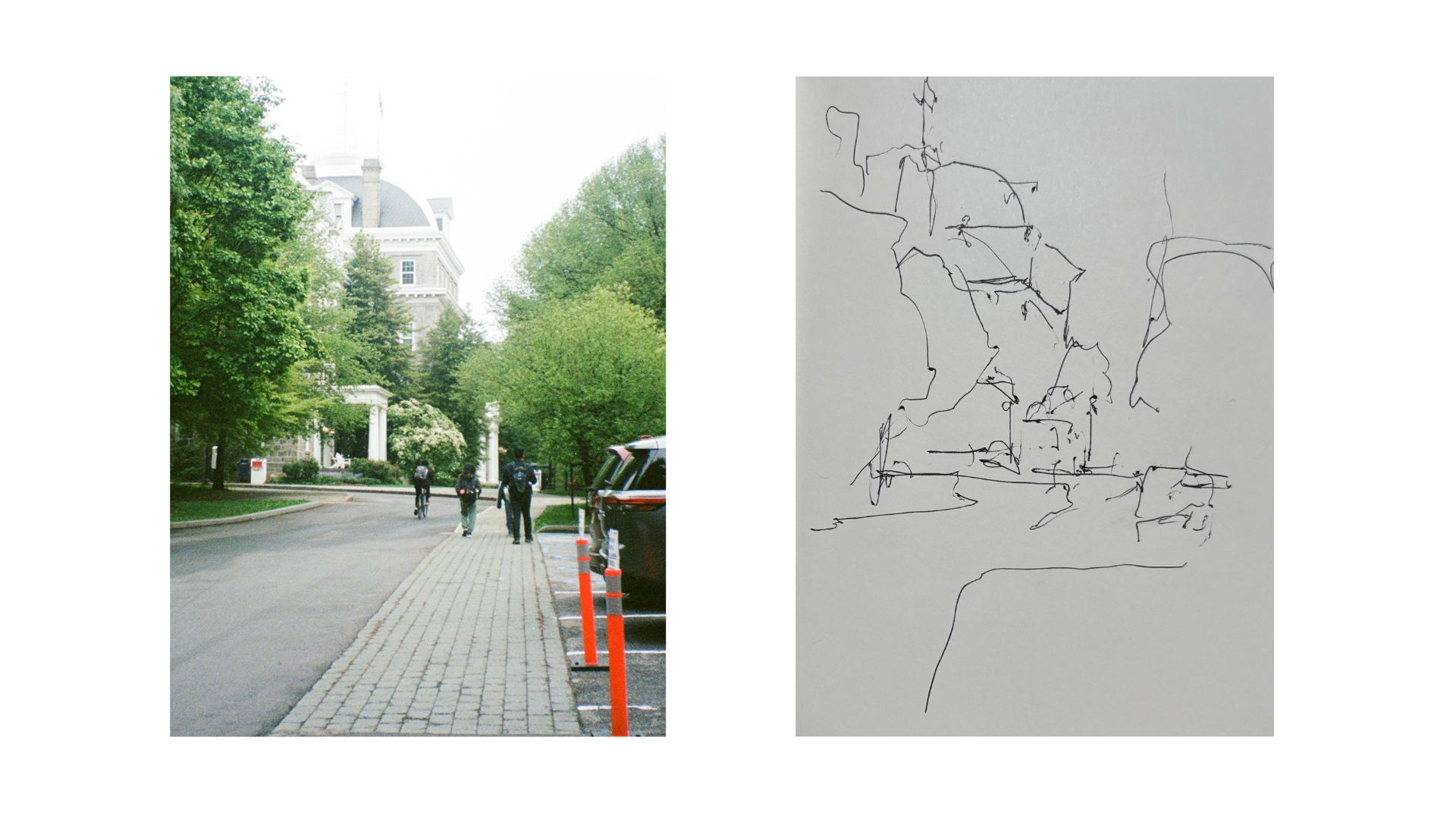
On my final evening before departing, my friends and I decided we would stay up until dawn for the last sunrise. I made my last drawings of campus from dusk to dawn, filling my sketchbook with the urgency for preservation. I thought about this in a very particular way, which was that I needed to just get this feeling, to catch a little bit of it. I had only eight hours or so left. I also did not have the luxury of light, because the next time it would return, I would be leaving. My friends were finishing their packing, we would not embark on our hike until about 2AM, the sun was about to set, and the ache in my chest grew opaque and my eyes were beginning to water. Imminent absence. I resorted to the immediacy of ink, and the satisfaction of a direct, unalterable mark. I walked along the pathways in negligible light, overwhelmed by such fierce emotion that softened my body the way the rain softened the paper, I traced the architecture and the trees as much as I traced the feeling.
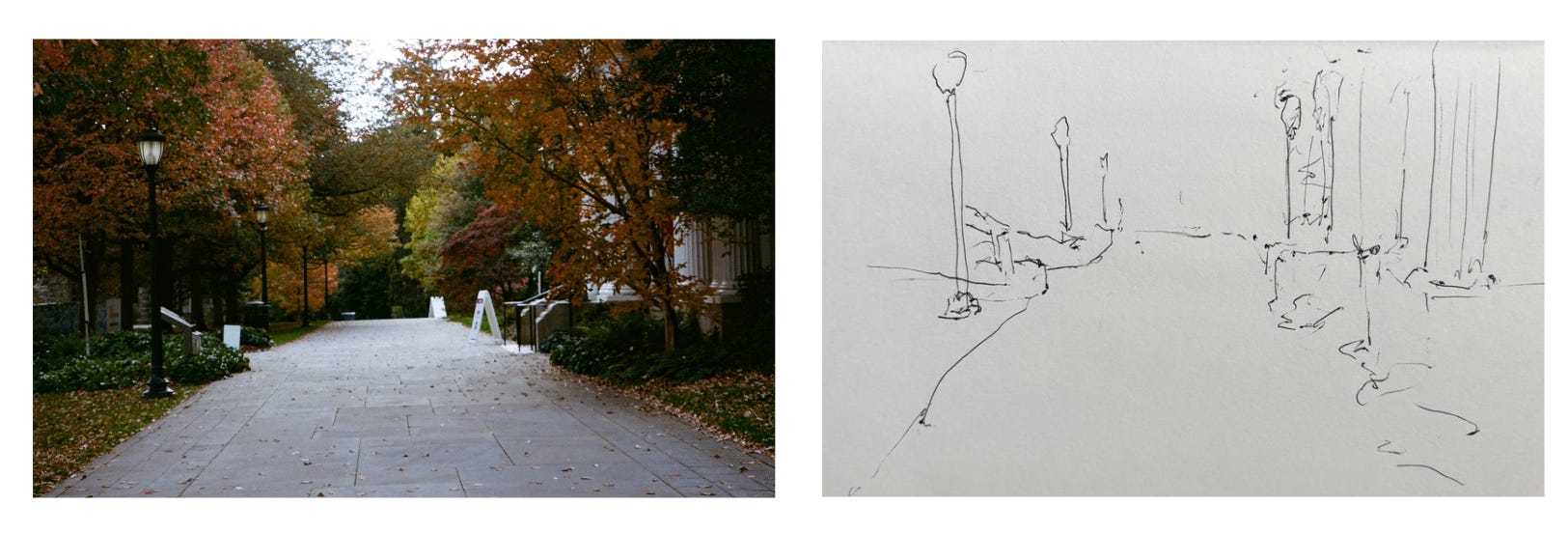
The five of us walked for four or so hours into the morning, across damp grass and gray stones collecting sweat from a week of storms. There was a flux to our bodies and to the solidity of that little window in time. Sitting in one place for too long brought with it a sickness of exhaustion, and so we moved and moved and moved. It would be the last time bearing witness to an environment so self enclosed and emptied of its routine, in the fragile intimacy of a final morning, all of us together. Something about the clouds felt appropriate, and yet I always complained about the way they choked my mood. Instead, they recapitulated the timeless sensation of the recent past, as dawn to dusk grew indistinguishable, veiled by this consistent, indifferent, dimly lit sky. It only pressurized my urgency, as it intensified my responsibility to mark the time as it tumbled violently. I have wrestled with the realization that I will soon forget much of this.
Something fundamental shifts in these last few moments before the consecration of memory. The environment transforms into an altar, and into evidence. I returned to my emptied dorm room earlier that night, after our commencement ceremony, with a rawness I had struggled to articulate. This feeling– something about finality– the feeling I’d get on Sunday mornings where I’d wish it was Saturday, so that the time didn’t drop off into the week’s abyss; something about seeing the hallways and paved paths removed from the habits I had settled into, that had formed the structure of my day to day, leaving only a silhouette or echo of ritual. I wonder if Kora felt the acute pulse of time before her lover was to depart, if that tightened her muscles the way it tightens mine.
III. The Love (Eros) of It: Plato’s Symposium
Painting or Love. The single things in my life that construct and reconstruct purpose. I remember when I was twenty, I laid on the grass across from these paintings and thought I had found love. I was overwhelmed to have found a way to be in this world, their world. In these paintings I felt something that could be made and called real, even if in them was the representation of the unattainable. All this time, these centuries, have been the continual attempt to organize, to oppress, and to regiment the messy forces of inner life. In this place, for one moment, the two things that I want most in this world join within.
Ross Bleckner, Journals, Madrid, May 31 1988 (Examined Life, Writings 1972-2007)
Plato’s Symposium defines erotic love as a desire for completeness.6 The text recounts the drunken yap session during a celebratory dinner banquet, where Socrates’s cast of poets, playwrights and politicians each give their own accounts on eros: the form of intense passionate love and desire embodied by the God of its namesake. In Aristophanes’s speech, a third human once accompanied the male and female: two bodies conjoined in a circle, with four arms and eight legs. Zeus orders Apollo to separate them in half, and these halves spend the remainder of their lives searching for each other. Love thus comprises a lifelong quest for the other, to reobtain an ancestral completeness. This notion is still pertinent to modern ideas of romance. But the pursuit— this thing called love— is grounded upon incompleteness, which is much larger than its relation to another person.
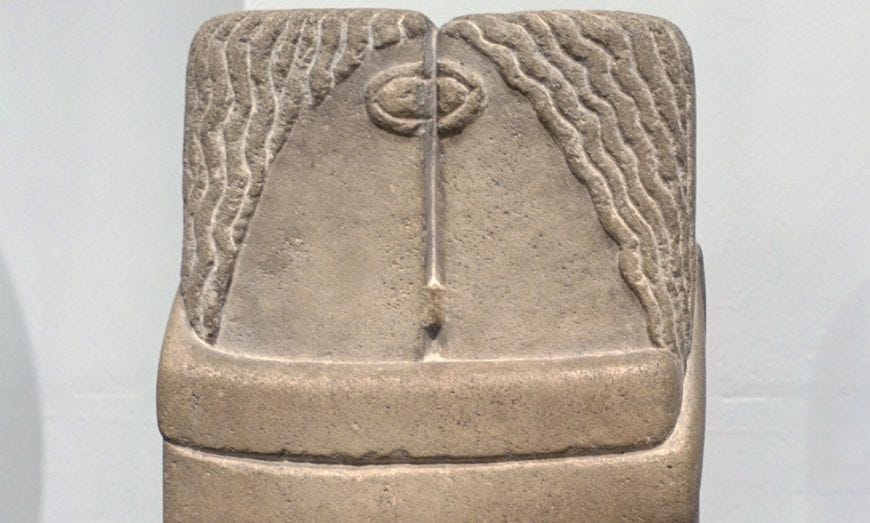
The ultimate object of love is beauty. Eros exists in the perpetual arrival at the Beautiful, insofar that is a search for the Beautiful.
This is what it is to go aright, or be led by another, into the mystery of Love: one goes always upwards for the sake of this Beauty, starting out from beautiful things and using them like rising stairs: from one body to two and from two to all beautiful bodies, then from beauiful bodies to beautiful customs, and from customs to learning beautiful things, and from these lessons he arrives in the end at this lesson, which is learning of this very Beauty, so that in the end he comes to know just what it is to be Beautiful.7
Diotoma famously claims that love is a “giving birth” in beauty; it allows for the creation and expression of ideas, objects, actions, myths that we grow pregnant with throughout out lives, that remain dormant and contained until love grants us permission to express. Love is the desire for what is good, and what is good is beautiful— but there something unique and distinct from any other endeavor to obtain “the good” (i.e. a good job, money, etc.) that envelopes the lover’s pursuit. Pausanius, in aligning eros with virtue, highlights the idea of subjection: love is a voluntary subjection (to another) in the name of virtue.
I am trying not to do much of my own philosophizing. But what I take from these constellations between the burning stars of beauty, love, memory, and incompleteness is that they interface within the work of art, in my case, drawing and painting. Love, like drawing and memory, is a confrontation with incompleteness. This mounting ache in my body, delivered from the finality of my collegiate life, enabled a fervent expression of the desire for wholeness. This desire, embodied in the drawing and the painting, was born out of incompleteness and died in the anticipation of absence. It is the lover’s profile I was desperate to trace in the shallow dawn of departure. For beauty and of beauty. It cannot be anything but love.
Natural History Book 35 Chapter 44, The Inventors of the Art of Modelling. Technically, Pliny attributes the origin of the portrait to the ceramicist Butades (Kora’s father), who “modelled” the young man’s face in clay based off of his daughter’s mark. He distinguishes between Butades’ invention of the portrait and Kora’s discovery of it. What does that mean, to discover a portrait? Importantly: Kora was deeply in love, and this aspect demands all seriousness. In love there is a searching, and searching is a desire for some completion or wholeness. Incompleteness thus belies the creation of the plastic art, with love as its vehicle.
Wassily Kandinsky in Point and Line to Plane (1926): The geometric line is an invisible thing. It is the track made by the moving point; that is, its product. It is created by movement— specifically through the destruction of the intense self-contained response of the point. Here, the leap out of the static into the dynamic occurs.
Rilke in Letters to a Young Painter (1920-1926): The pleasure of painting, of recapturing — in the slightly differing drama the painter stages for himself, making it emerge bit by bit on the canvas like an indefinite crisis in the process of being resolved.
My highschool IB biology teacher got me this book— a loving and profound letter of wisdom for young scientific researchers— as a graduation gift. I reread it last fall during a course on the “art” of biological research. My professor for this course, a developmental biologist, had us draw the stages of invertebrate development witnessed under the microscope as part of our research and coursework. Ramon y Cajal won the Nobel Prize for Medicine in 1906, in addition to writing and illustrating the first Spanish textbook on histology (microscopic anatomy). Drawing was tantamount to his discoveries of neural anatomy structure and organization, which he frequently describes in the book: ““If our study is concerned with an object related to anatomy, natural history, and so on, observation will be accompanied by sketching because, in addition to other advantages, the act of representing something disciplines and strengthens attention. It forces us to examine the entire phenomenon, thus preventing the details that commonly go unnoticed in ordinary observation from escaping our attention.”
Wassily Kandinsky in Point and Line to Plane (1926): “The street can be observed through the windowpane, which diminishes its sounds so that its movements become phantom-like. The street itself, as seen through the transparent (yet hard and firm) pane seems set apart, existing and pulsating as if “beyond.” As soon as we open the door, step out of the seclusion and plunge into the outside reality, we become an active part of this reality and experience its pulsation with all our senses. The constantly changing grades of tonality and tempo of the sounds wind themselves about us, rise spirally and, suddenly, collapse. Likewise, the moments envelop us by a play of horizontal and vertical lines blending in different directions, as colour-patches pile up and dissolve into high or low contalities. The work of art mirrors itself upon the surfaces of our consciousness. However, its image extends beyond, to vanish from the surface without a trace when the sensation has subsided.”
The Speech of Aristophanes, ~189-192. I use “erotic” in the context of the Symposium’s discussion of Eros, God of Love. Not to be confused with the modern interpretation/definition of erotic as that which is exclusively sexual, though of course sexuality comprises an important part of erotic love. The link exists in a longing for completion, fulfillment, you get where I’m going. I hope.
Speech of Diotoma, 211B-211D